Flower of a sustainable future
Inspiration for the tool
André Chauvet, from the Green Guidance Lab
Introduction
In the face of ecological and social crises, many people, both young and adults, experience a mixture of anxiety, helplessness, or guilt. In the field of guidance, these questions often emerge as reflections on the meaning of work and the impact of professional choices on the world. However, these reflections can remain abstract or paralyzing if they are not accompanied by a space to identify concrete and accessible actions.
This activity provides a simple framework to collectively initiate reflection on the impacts of work and lifestyle on the environment and society, while identifying small possible actions to contribute to a more sustainable world. It enables participants to move beyond a purely individual perspective and to highlight different forms of engagement: learning, supporting, changing, or creating.
Objectives
By the end of the activity, participants will be able to:
- observe and clarify the environmental and social impacts of work and lifestyles
- identify concrete actions to contribute to a more sustainable society
- explore different forms of engagement (individual and collective)
- strengthen their sense of agency at their own scale.
Resources needed
- A3 sheets or flipchart paper
- markers or pens
- optionally, sticky notes
- draw the diagram on a whiteboard/flipchart, e.g., in French below:
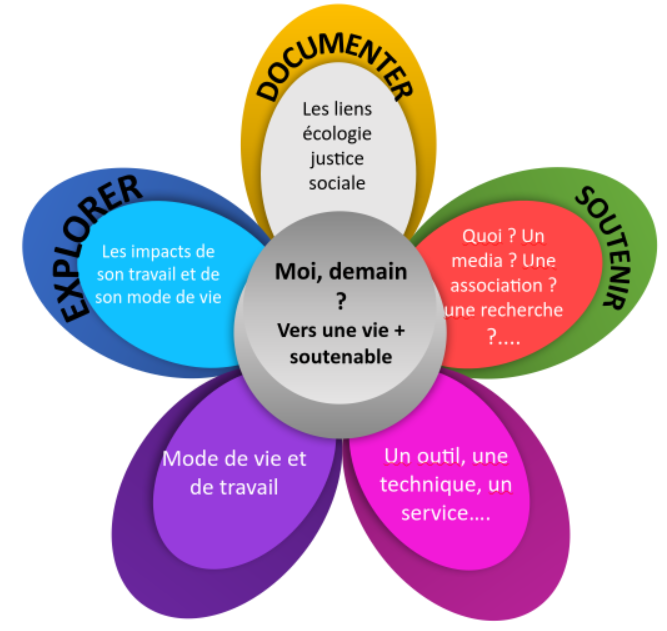
Proposed Reflection Model:
| Explore | Learn | Support | Change | Create |
| What can I observe or explore regarding the impacts of my work or my lifestyle? | What can I learn or seek to better understand? | What (Whom?) can I support? | What can I change in my life or in my work? | What can I create or initiate? |
Activities
1. Introduction
The facilitator introduces the activity by noting that many people today wish to contribute to a more sustainable society but do not always know where to start. The objective of the activity is to identify small possible actions, at different scales, that can contribute to a lifestyle and professional activity more aligned with ecological and social challenges.
You can introduce the reflection with the following quote:
“What you do makes a difference, and you have to decide what kind of difference you want to make” Jane Goodall, scientist and activist
2. Individual or Small Group Reflection
Present the reflection diagram (optionally drawn on a board/flipchart) and invite participants to reflect on the different categories of action. Explain that the goal is not to find perfect or radical solutions, but to identify realistic starting points.
Explore
Invite participants to reflect on what they could observe or explore further. For example:
- explore the environmental impacts of their work
- reflect on the impacts of their modes of transportation
- observe the practices of their organization or professional sector
Learn
Encourage participants to reflect on what they could better understand or deepen. For example:
- the links between ecology and social justice
- the environmental impacts of digital technology
- the transformations of work related to the ecological transition
Support
Ask participants what they could support or encourage. For example:
- an independent media outlet
- an organization or local initiative
- a research project or association
Change
Invite participants to reflect on small possible changes in their lifestyle or work. For example:
- modify certain transportation habits
- reduce certain polluting practices in their work
- discuss these issues with colleagues
Create
Finally, invite participants to reflect on what they could initiate or create.
For example:
- an initiative in their community
- a project in their organization
- a tool or educational activity (for career guidance and counseling professionals)
3. Collective Sharing
Participants then share some ideas with the group. The facilitator can group the suggestions on the board to show the diversity of possible actions and the complementarities between them. This step highlights that the transition toward more sustainable lifestyles and work does not rely solely on individual choices, but also on collective dynamics and shared initiatives.
Extension Activities
To deepen the reflection, several approaches can be proposed:
- identify a small concrete action to test in the following weeks
- reflect on possible alliances with other people to act collectively
- discuss the obstacles encountered when seeking to change certain professional practices
- explore how these actions could influence future career choices or professional practices
Reflection/Learning Consolidation
Invite participants to reflect at the end of the activity:
- Which ideas seem most inspiring or motivating to you?
- Have you discovered new ways to contribute to the ecological and social transition?
- What small action seems possible for you to try in the coming weeks?
- What forms of cooperation could facilitate these changes?
- How might these reflections influence the way you think about your work or your professional future?