How “Green Guidance” is put into practice at the Lower Austrian Education and Career Guidance Service
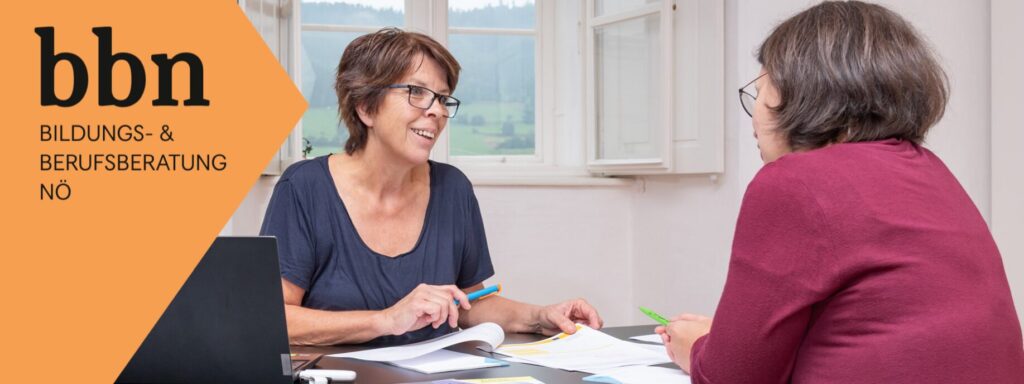
The Lower Austrian Education and Career Guidance Service (abbreviated to bbn) is aimed at people aged 15 to 64 who have questions about education and careers. These can range from very specific queries, such as “Is there funding available for the further training I’m planning?” to complex issues of career reorientation, such as “Am I doing the job I really want to do?” or “What are my strengths and how can I apply them in my career?” Over 10,000 people make use of the service each year. Consultations take place at over 90 local centres as well as online, via video, telephone or email. Around 30 counsellors have their hands full ensuring that the diverse range of concerns are addressed in a client-centred, resource- and solution-oriented manner.
bbn wants to be part of the transformation process!
Educational and career guidance is part of the social system; on the one hand, it works within the existing framework, and on the other, it actively helps shape the system. When the ILO (International Labour Organisation) states that the transition to a greener economy will lead to the creation of new jobs in environmentally friendly production processes and sectors, this has implications for our advisory work. That is why we cannot simply carry on as before! Just as all sectors of the economy and society must continue to evolve, we at the Lower Austrian Education and Career Guidance Service are actively addressing the pressing challenges of our time and are convinced that we are part of the transformation process and can make a valuable contribution to the European Green Deal, the Paris Agreement, a sustainable economy, a just society and a healthy environment.
The 10 Approaches to Green Guidance in Lower Austria
Inspired by the 2021 Euroguidance conference with Peter Plant in Vienna, the topic of ‘Green Guidance’ stayed with us, and we engaged in a collaborative process to consider how ‘Green Guidance’ could be successfully implemented within our guidance network. We discussed possible strategies and drew up a comprehensive catalogue of measures.
Step 1: Finding someone responsible: Right from the start, it was clear that the network needed people to champion the topic and engage with it on an ongoing basis. The “Green Guidance” working group was set up with the aim of integrating Green Guidance into our project work in the long term. The eight-member team of consultants and project managers meets at least six times a year. It sees itself as a hub, developing concrete measures for consultancy and networking, connecting with experts, and much more.
Step 2: Offering further training: Our advisers are constantly required to keep abreast of the latest developments and expand their knowledge. That is why it was important to us to provide appropriate further training opportunities for our advisers. In addition to seminars on various topics (environmental certification for businesses, the Sustainable Development Goals, etc.), annual field trips to green businesses and training institutions have proved particularly valuable. In addition, there is regular information on the labour market, sustainable training and further education, as well as the introduction of new advisory tools and the critical review of existing tools through the lens of sustainability.
Step 3: Advisory focus: Clients should be provided with comprehensive information and support when they enquire about green careers, job platforms, funding or (part-time) training and further education. Likewise, the sustainability aspect should be actively incorporated into career guidance and decision-making consultations in order to broaden perspectives, stimulate out-of-the-box thinking, enable empowerment, offer opportunities for reflection on personal values, and facilitate discussion of new paths. To this end, a dedicated counselling format entitled “Working for a good future – pathways to sustainable careers” has been developed, which is offered in both individual and group settings.
Step 4: www.greenjobs-noe.at/Erwachsene: Through our collaboration with the Province of Lower Austria (Department of Environment and Energy Management), we were able to expand the existing website to include an ‘Adults’ section. The website serves as a source of information and research for clients, as well as a working tool for advisers. In short, the site provides definitions, details of the wide range of green careers, (part-time) training and further education opportunities, examples of green businesses in Lower Austria, and a variety of initiatives and organisations extending far beyond Lower Austria.
Step 5: Exchange and networking with multipliers: Good and regular cooperation within a wide variety of networks at local and regional level is one of the quality criteria of bbn and is also increasingly put into practice in the field of sustainability. The ‘Green Guidance’ working group, for example, established links with the province’s Energy and Environment Agency, the European Climate Protection Training Centre, the Climate and Energy Fund, the Voluntary Environmental Year scheme, the AMS, and the Environmental Foundation. The relevant information gathered and potential next steps were shared within the network.
Step 6: bbn’s regional approach: Whilst the successful provision of advisory services at around 90 locations across Lower Austria does mean that advisers have to travel many kilometres by car and train, it also ensures that clients’ journeys are kept as short as possible. Furthermore, where possible, consultation times and venues are coordinated with public transport timetables, and clients are informed about the option of travelling by public transport.
Step 7: Embedding sustainability: bbn is gradually incorporating the theme of sustainability into all its strategic frameworks, such as its mission statement, quality policy and quality circle. This creates a fundamental and more comprehensive awareness both within and outside the organisation.
Step 8: Making our own work greener: This step is well known but still requires greater attention. It involves purchasing sustainably (e.g. office supplies) and working in a thrifty (e.g. reducing electricity consumption), efficient (e.g. extending the lifespan of equipment) and resource-conserving (e.g. using less paper) manner. This requires a personal commitment from all staff members that goes beyond their actual job description.
Step 9: Public Relations: bbn is committed to producing all promotional materials as sustainably as possible (using certified printers, paper instead of plastic…) and organising our events in a sustainable manner. This includes, for example, the venue itself, by selecting seminar hotels with sustainability certifications. We ensure travel options by train or organise carpooling. For catering, we source regional products from social enterprises. Furthermore, ‘green’ testimonials (such as women in sustainable technical roles) and success stories will be regularly highlighted on our social media channels.
Step 10: International cooperation: Thinking outside the box is particularly crucial in the field of ‘Green Guidance’. Through its active participation in Europe-wide meetings and events organised by Euroguidance, Erasmus+, NICE, green-guidance.eu, etc., the Lower Austrian Education and Career Guidance Service has already established a network that extends far beyond the region’s borders; it shares its own experiences and benefits greatly from the experiences of others. For example, two Academia Study Visits on the topic of “Green Jobs – Green Skills – Green Guidance” have already been organised in Lower Austria, each attended by guidance practitioners from eight different countries.
The Lower Austrian Education and Career Guidance Service will continue on this path, as we are convinced that only a sustainable transformation of the economic and social system can provide the foundation for a bright future for us all and for future generations.
______________________________________________________________________
For further information and to get in touch: Education and Career Guidance Lower Austria (bbn), www.bildungsberatung-noe.at, Project Manager DI Rosemarie Pichler, r.pichler@bildungsberatung-noe.at, 0043 676 6418 384